In the early 80s, my parents went to garage sales and bought me tons of used Lego sets. None of the sets were anywhere near complete, and most of them didn't even come with a picture of the set they belonged to.
My parents just dumped everything into a large bin and gave me no instructions other than what the shape of the blocks themselves suggested. There were parts of cars, parts of airplanes, parts of castles and police stations and pirate ships.
So I made flying cars, pirate castles, police ships, and everything in between.
Later, when my parents could afford to buy me a brand-new Lego set for a special occasion, I wouldn't even try to build what was shown on the cover. All the new blocks would go into the bin with the old ones, and I'd mash them together to build crazy things.
I think those Lego blocks made me become a programmer.
These days, when I browse the Lego section at any large toy store, all I see are heavily customized ("licensed") sets that seriously restrict what you can build with them. The bow of a ship is no longer a jagged stack of rectangular blocks; it's a large, smooth, custom-molded piece that can't easily fit in anything but a ship. They look beautiful, like a nice iOS app, but they no longer inspire creativity like they used to. Instead of Minecraft, you get FarmVille.
I could still build a pirate-themed spaceport with that set, of course, if I had a lot of rectangular pieces. But most sets don't contain a lot of versatile, rectanguler pieces anymore. You need to buy a very large set for that.
So maybe that's part of the reason why we think Lego is getting more expensive. There have always been small, cheap sets and large, expensive sets. But unlike in the 80's, most of the small sets are no longer worth buying. They are so heavily themed and custom molded that the average kid can't do anything truly creative with them. Serious players are therefore forced to buy large, expensive sets. Because if you buy a 1000-piece pirate ship, maybe half of those pieces will still be useful when you later decide to build a nuclear missile silo.
Some time ago, I heard that you could just order a bag of generic blocks from Lego. I wonder if this is true, because if and when I have kids, I'd like to buy them that. Or maybe I'll just ask my parents if they still have my old bin of mismatched secondhand bricks.
> These days, when I browse the Lego section at any large toy store, all I see are heavily customized ("licensed") sets that seriously restrict what you can build with them. The bow of a ship is no longer a jagged stack of rectangular blocks; it's a large, smooth, custom-molded piece that can't easily fit in anything but a ship.
This is another example of the rose-colored nostalgia the article mentions, I think. Lego ships have always used dedicated boat parts for the hulls, starting in 1973 with the Tugboat (http://lego.wikia.com/wiki/310_Tugboat) that kicked off the Legoland Boats line; the Pirates line that debuted in 1989 did the same, starting with the Black Seas Barracuda set (http://lego.wikia.com/wiki/6285_Black_Seas_Barracuda). It makes them much more seaworthy for bathtub play. The Legoland Boat sets used to come with a special weighted keel piece for the bottom to keep ships upright in the water; I don't know if the pirate ships do, but of course you can always re-use the ones from the boat sets.
> So maybe that's part of the reason why we think Lego is getting more expensive. There have always been small, cheap sets and large, expensive sets. But unlike in the 80's, most of the small sets are no longer worth buying. They are so heavily themed and custom molded that the average kid can't do anything truly creative with them.
This is definitely not true. I don't have the money for big shopping these days, but every time I'm at a Target I like to pick up a little $5-$10 kit, ideally one of the mini vehicles. I always get hours of fun building and fiddling with the little things.
I feel like "Lego sucks now" has become a meme that people just repeat without ever actually testing it. They look at a few kits in the store, pick out whatever details fit their preconceptions, and sneer about it on the internet. Try it! Go down to the store and buy a Lego kit. If you don't like the licensed jobbies, I highly recommend the Creator line; they tend towards straightforward vehicles and animals and robots and stuff, and most of them actually come with complete instructions for three different things per set. I think you will be pleasantly surprised.
Yep, I remember the exact same discussion back in the late 80s/early 90s when 1980-Something "Classic Space"[1] gave way to Futuron[2] among others.
Given how nearly everyone tends towards "kids these days" comments over time, I'm certain you're right and the same conversations were happening in the decades before that, too.
Also, when I played with Lego (that was actually during the dark times, the late nineties and early 2000s) I actually loved special and weird pieces I would get in sets (excluding pieces with stickers)!
If those pieces weren’t overly large and specific at the same time – and they rarely were – my growing collections of weird bits and pieces could be endlessly repurposed in cool new builds. I was always on the lookout for cool new computer monitors or cool new wheels or whatever to build cool new things with.
I would definitely agree that the late nineties and early 2000s were aesthetically a dark time for Lego and I actually prefer the aesthetics of today’s Lego sets (colors, part choice, building styles), but I’m not really aware of any kid for whom those sets – the standard ones you could always get, the police station, train station, the space shuttle, the cargo train station, the passenger double-decker train (ah, memories) – were the be-all end-all. They were always just a starting point and the whole things was to repurpose them and you really always could with those sets. And then those weird pieces were a cool assest that allowed you to be more specific.
I can see the ascetic ways of building only with four types of blocks or so, sure, but I’m not sure that’s something I personally would have enjoyed. I liked my weird bricks.
My pirate ship did have some custom parts for the hull, but it most certainly didn't look like that Tugboat. The hull came in several pieces, each of which could be easily repurposed for other uses because they had rectangular edges for other pieces to attach to. I don't think this is just nostalgia messing with my memory. The damn ship didn't even float, because water leaked through the gaps between the pieces.
I admit that I may be biased because of the particular selection of Lego sets at the stores in my area. But if Lego itself hasn't changed, at least their marketing focus seems to have changed.
The Pirate ships have pretty much always had hulls that were large modular pieces, but not completely sealed.
The Tugboat was one of a long line of floating ships; they all had one-piece hulls so that they'd be completely watertight.
Though you could get the pirate ships to float if you used ballast and sealed them off with the right bricks; I got mine to float in the backyard pool.
Unfortunately, the only "generic" pieces available for sale in my country seem to be baseplates and 2x4 blocks in assorted colors.
I miss the svelte 1x16 pieces. They made such excellent beams for the large and airy structures that I liked to build, but they must have been part of a very unusual set because I can't find them anywhere else. :(
Unfortunately, I don't know what shipping is like to your country, or if sellers will be reluctant to ship there. I'm in the US, so it's never come up for me. Good luck, though!
I'm glad that there are (semi-) complicated kits that my kid can build. For his 4th birthday there was one with a 48 step instruction manual. That's an achievement (others might already build more complicated ones, but he didn't have small Lego before that). After a while these "builds" gradually fall apart and other things are being built.
Creativity is not the only thing that can be encouraged. Building complicated things from instructions is also an important skill. And there is still plenty of creativity to be trained while playing with the finished models.
I think you can not bemoan that LEGO is so important for raising engineers and then demand that they only have "creativity bricks".
As a counter point, I loved all of those specialized sets as a kid -- Blacktron and M-Tron were especially awesome. Plain rectangular bricks can be boring and need some custom pieces to spice things up.
I'd say it takes a different kind of creativity. One is not necessarily better than the other, they're just different.
If you got bored with plain blocks and had to "spice things up" with custom pieces, it means you had plenty of plain blocks at your disposal. That's how I like my Lego sets, too. A large number of plain blocks with a few custom blocks here and there. Not custom blocks galore like some of the newer sets tend to be.
You can buy buckets of generic bricks but they're hard to find in toy and department stores. I'm in Australia and gave up trying to find generic stuff in stock here and ordered in Duplo from Amazon for my two year old.
He has airport and train sets (gifts from family), plus bulk bricks, which means he can get a mixture of general building experiences, plus specific things to combine with them. Works well.
The linked set is discontinued. There are several different sets of basic bricks (of various sizes), currently branded under the Classic "theme": http://shop.lego.com/en-US/Classic-ByTheme
That's exactly what I found with my kids. You've got to buy far more expensive modern sets to get the same number of generic any-pieces than you used to.
So the price of free form creativity with lego has indeed gone up.
As mentioned by other commenters, the Creator series has sets with more generic pieces. And you can easily buy large quantities of generic pieces, at least in the US.
This is very interesting because I as I'm sure many did agreed with the sentiment at the time and assumed that community was trying to create some sorta social commentary about how toys have become expensive, but now we see that the price of legos hasn't actually changed so much, though it's had a long term downward trend.
I think Community was more making a comment about how Lego has become less generic and more based on marketing. You could say this correlates to less creativity in favor of recreating existing properties. The bits about smaller pieces and brand tie-ins line up with the changes mentioned in the article (more pieces per set, more brand specific sets).
Another factor that the article doesn't consider is the utility of each Lego brick - if there are a large number of unique pieces in each set then you need to buy more Lego sets to get the available bricks, and the bricks have less reusable value in models built from your imagination. For example, a child can't as easily take a set that's designed to build a car and use the bricks to build a dinosaur instead because there are too many "car specific" pieces.
Measuring the usefulness of pieces would be tremendously hard to include in any mathematical model (pun not intended).
You are underestimating how creative children are. I used to get a lot of Lego sets as a kid, and they would get assembled and then disassembled within two days max. And yes, I can confirm that a Lego Technic excavator with an electric motor and pneumatic controls can be used to make a dinosaur(and then to make a city block. And a spaceship. And a train.).
And in fact, it looks like Lego company is encouraging you to experiment too - look at the Lego Movie sets. Every single one uses weird, "specific use" pieces which are used for something completely different than what they were originally intended for.
> Not all old LEGO sets fetch such high prices, but of course all the popular ones do. These are the ones that we wanted when we were younger, and now that we have a bit of our own money we want to buy those dream sets from our childhood.
Many toys from our youth now command incredible prices because of this phenomenon. Retro video games can command absolutely obscene prices (four and even 5 figures sometimes). My Neo Geo collection in particular is worth dramatically more than what I paid for it.
The thing is, most old video games (at least the especially popular ones) are available as emulators and sometimes are refreshed by the publishers too.
Lego sets need not be old to be fun as I can attest from a recent impulse purchase.
> The prices of the toys we had as kids comes as a shock. $150 for a toy? $200 for a toy? These prices are outrageous.
I remember having an encyclopaedic knowledge of the prices of Lego sets (and Transformers) during the 80's. I'm pretty sure I'm not the only one. Most of my friends in primary school knew how much the latest Technics racing car, or indeed the original G1 Megatron (banned in the state I lived in, so notorious and highly coveted amongst us [1]) would have cost our parents.
One of my friend's dads drove to another state and paid $90 for Megatron before it got banned in that state as well. For that act, according to us at the time, he won dad of the year.
I purchased the Lego Space Shuttle in October, 2012 for my nephew for $94.99. I had so much fun putting it together with him a couple years later that I decided that I want one myself and it's now at $300:
I know this because Amazon has a notification at the top to tell me that I purchased it in 2012 and I can see the order. In the span of 2.5 years, it's tripled in price.
I wish he had done a graph of the prices for the same sets over time. That way I can compare if it is the Space Shuttle set that's skyrocketed in price or if it is across the board.
The last first-party price change ($84.97) corresponds to a steady and sustained increase in third-party price, so I'm assuming they discontinued the product in December of 2013 and the price is now driven by market forces. Just looking at other recommended space sets, I'm seeing prices jump 2x to 3x between when they were discontinued and now.
At first glance, looks like the only unique parts are the sticker set (~$5-$17) and the minifigs ($3-5). How many other parts you need to buy would depend on the size and variety of your collection.
My son is of the age where his wish list for birthdays and Christmas is usually at least half Lego, and the wallet is definitely feeling it :)
Wish there were some Lego compatible bricks with liberal licensing, so that they can be freely designed by the community, and manufactured by several manufacturers. Would be even cooler if there were Mindstorm style robotics kits like that with open source licensing.
A large part of the population (especially outside 1st world countries) is excluded from the joys of plastic bricks due to price.
I'm also excited about the possibilities of expanding LEGO kits with 3D-printed parts as print resolution continues to improve. You can already achieve some cool things by gluing LEGO pieces to 3D-printed parts, but that seems like cheating. http://www.thingiverse.com/thing:403
I cringe at the "I wrote a web scraping program to go through the Brickset database". Brickset and Rebrickable both have awesome APIs that can provide all this data in an easily digestible format.
but he wrote a web scraping program for mining the data, bonded it together using wget, launched several aws instances with hadoop, and deployed a mapreduce job for cleaning up the data. It took three weeks and $200 usd, but damn, modern technology is awesome, it would be impossible to do this just 10 years ago.
I had a Gilbert Erector Set, a competitor to Lego. I confess I always thought the erector sets were better, and looked down on Lego. Metal held together with nuts and bolts! vs plastic bricks. It was no contest. But who has heard of erector sets these days? Gilbert lost the marketing war.
The problem that I have with Lego isn't the cost of them, the price-per-brick or whatever. The problem is that when I go to Target or someplace to just buy a big tub of generic bricks--like I grew up with--I instead see an aisle packed full of special-use packages. I don't want Harry Potter or Pirates of the Carribean or super-specialized Technics...I just want a big gallon of assorted, simple bricks.
Seriously, it's like Lego has somehow turned into the same microframework hell that Javascript has--hundreds of toolkits, all useless outside of their niche.
Perhaps you need to go to a different store? Lego City is still by far the biggest representative in most stores I visit. Whilst they do have Star Wars, Marvel/DC, Minecraft etc, their own branded pirates, Ninjago and Chima represent a far bigger slice of their offering across their range.
If you're after something even more generic than that, Lego have always had "creative" boxes available as well. They've actually just come out with a new series: http://shop.lego.com/en-AU/Classic-ByTheme
I think the inventory carried by retailers is more driven by marketing theme sets, but LEGO itself still carries generic building sets. (e.g. http://www.amazon.com/LEGO-Ultimate-Building-Set-Pieces/dp/B...) You can even IIRC order specific parts in bulk directly from LEGO. But if you google, bulk lego, the most likely thing you'll come across lots of ways to pickup large amounts of used bricks from ebay or similar sources.
I played with Legos a ton as a kid, and I have a completely different view on what made Legos good. Building Legos with only basic bricks can be fun, but there's only so much depth to it. It was actually the special pieces that enabled you to make really interesting things, and I didn't feel like they stifled creativity at all. Not having the special pieces would be like cooking with only flour, butter, salt, and water. You can probably make a few tasty things, but I don't think you would want to eat that every day.
Looking at the Lego website, that does seem to be the case - but I couldn't tell if that has always been the case. Many of the sets don't look like you'd have much freedom other than to follow the directions due to the large number of set-specific pieces.
Paying ten cents for a bring you can reuse hundreds of time is much cheaper than paying ten cents for a brick that can only be used once and has to be kept with its mates in order to preserve the "value" of the kit.
Also, paying suggested retail price for an "in demand" kit is unheard of. When my nephew got the "Black Pearl" for Christmas a couple of years ago, his parents paid $250. TIL the MSRP was apparently $100 (although that information was not available to them at the time.) If someone knew they were paying $250 for a $100 kit, maybe they wouldn't think it was Lego who was ripping them off.
They do make a couple of generic bins. ($0.61/brick on Amazon) and you can pick up clean lots on eBay. Though I've not seen it myself I'm also told you can buy from bins at the Lego stores.
I know what you mean though, as none of these yields exactly the set I'd prefer (lots of variety in very few colors).
Those are not actual lego sets. They are pieces broken out of lego sets that are no longer sold. It's marketed by a third party seller to the collector's market. Each figure came from larger sets. I'm sure you are aware of this, yes? And if so, you agree that your post is very misleading, yes?


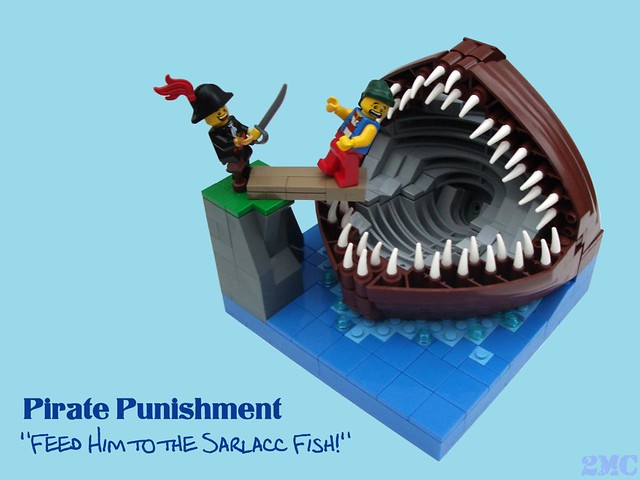
My parents just dumped everything into a large bin and gave me no instructions other than what the shape of the blocks themselves suggested. There were parts of cars, parts of airplanes, parts of castles and police stations and pirate ships.
So I made flying cars, pirate castles, police ships, and everything in between.
Later, when my parents could afford to buy me a brand-new Lego set for a special occasion, I wouldn't even try to build what was shown on the cover. All the new blocks would go into the bin with the old ones, and I'd mash them together to build crazy things.
I think those Lego blocks made me become a programmer.
These days, when I browse the Lego section at any large toy store, all I see are heavily customized ("licensed") sets that seriously restrict what you can build with them. The bow of a ship is no longer a jagged stack of rectangular blocks; it's a large, smooth, custom-molded piece that can't easily fit in anything but a ship. They look beautiful, like a nice iOS app, but they no longer inspire creativity like they used to. Instead of Minecraft, you get FarmVille.
I could still build a pirate-themed spaceport with that set, of course, if I had a lot of rectangular pieces. But most sets don't contain a lot of versatile, rectanguler pieces anymore. You need to buy a very large set for that.
So maybe that's part of the reason why we think Lego is getting more expensive. There have always been small, cheap sets and large, expensive sets. But unlike in the 80's, most of the small sets are no longer worth buying. They are so heavily themed and custom molded that the average kid can't do anything truly creative with them. Serious players are therefore forced to buy large, expensive sets. Because if you buy a 1000-piece pirate ship, maybe half of those pieces will still be useful when you later decide to build a nuclear missile silo.
Some time ago, I heard that you could just order a bag of generic blocks from Lego. I wonder if this is true, because if and when I have kids, I'd like to buy them that. Or maybe I'll just ask my parents if they still have my old bin of mismatched secondhand bricks.