As you can see here - http://www.zetterberg.org/Lectures/l96bTab/doubling.htm. More industrialized regions have slower growth rates. Africa will double in just over 20 years while North America will double after over 100 years, for example.
Many countries, like japan and Italy are finding their population is actually shrinking, this tends to be bad for economic reasons. The US gets a lot of population growth from immigrants which keeps the country growing despite having only about 2.0 children per family (2.1 is optimal for maintaining a steady population.)
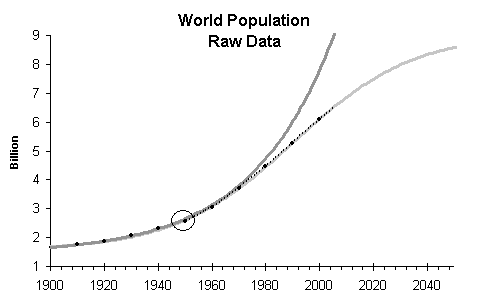
Asimov was working off a population model proposed by Malthus in 1798 [0], which has long been known to be flawed. It's not just industrial human populations that have slowing growth rates; most populations creatures have slowing growth rates as they near the population level the environment supports. The most common model for this is called "logistic growth" [1].
The "current doubling time" is kind of a misnomer -- it's how long it would take the population to double given the current growth rate, but the rate itself is also shrinking. Human population growth reached its peak (percentage-wise) in the early 1960s [2] and most credible estimates now have the world population leveling off in the 9-12 billion range (less than a full doubling from current levels) [3].


As you can see here - http://www.zetterberg.org/Lectures/l96bTab/doubling.htm. More industrialized regions have slower growth rates. Africa will double in just over 20 years while North America will double after over 100 years, for example.
Many countries, like japan and Italy are finding their population is actually shrinking, this tends to be bad for economic reasons. The US gets a lot of population growth from immigrants which keeps the country growing despite having only about 2.0 children per family (2.1 is optimal for maintaining a steady population.)