I'm in BC. The astro-nerd in me would have preferred to see permanent Standard Time instead of a permanent +1 offset. Instinctively, I think morning light is important to our biology for a daily reset and the solar cue of "high noon" is also a real thing. I'm sure I've read that sleep health experts have historically supported a change to permanent Standard Time, not DST.
I respect there are economic arguments for permanent DST. But I question the road safety stat I hear with announcements like this. Kids walking, biking, and being driven to school in mornings in darkness ... that's also what permanent DST gives us.
Oh well, I am in the minority it seems. So R.I.P. "high noon" ... I'll never see you again here. And, yes, I understand that depending on where one is within a time zone, a true "high noon" is only in theory. But it's a nice ideal. :-)
> Instinctively, I think morning light is important to our biology for a daily reset
I'd bet people would happily trade away the inkling of light they get during their winter commute before locking themselves into their office for some extra daylight when they leave that office.
Daylight is most enjoyable if you can actually make use of it.
> the inkling of light they get during their winter commute
It's not an inkling. Unless you roll out of bed and instantly onto your commute, you're getting natural sunlight through all your windows for hours every morning. That's exactly when you need it.
> you're getting natural sunlight through all your windows for hours every morning
Hah "hours". Not in Northern Europe you're not. My commute is dark on both sides. If I had to choose which side I'd prefer to be brighter I'd prefer the end of the day rather than feeling like my daylight has been wasted in the office. I shift my schedule in winter to make up for this as best I can.
I guess. I'm at 46 degrees and civil twilight at Christmas starts at 7am. I get up at 6:30, so yeah, dead of winter, I spend 30 minutes in darkness. But that's better than 1:30.
I guess it kinda hinges on this idea of "wasting" daylight. I don't feel like that. I want the sun to wake me up, and have no problem doing whatever I like when it's dark in the evening. Do people generally go on hikes after work? I go out for drinks. haha
56 degrees here (Denmark, and grew up in Ireland @ 53 degrees).
> I guess it kinda hinges on this idea of "wasting" daylight. I don't feel like that. I want the sun to wake me up
The problem is that during the darkest parts of winter, even if I postpone my wake up as long as possible, I'm still getting up in the dark if I want to be able to commute into work on time. There's no sunlight waking me up.
> Do people generally go on hikes after work? I go out for drinks. haha
No, but I still have to do things like walk the dog, do the shopping on the way home. I find it a lot more pleasant starting out that part of day with a bit of sunlight.
Also, yes, drinks. This is Northern Europe after all.
EDIT to add: Civil twilight in December where I am starts ~07:40, and I also get up around 06:30 (when not dealing with insomnia like tonight).
Also from Denmark, but I would prefer permanent standard time (just like it was prior to 1982); yes, it's still dark in the morning, but at least I won't have to wait months before I start seeing sunlight for my commute. I can only manage the darkness for so long, before the winter depression truly takes hold. Permanent summer time would be devastating to a lot of people here.
07:40 still sounds pretty early when compared to 66 degrees where we could expect the civil twilight after 09:00 in December. You'd go to school at 08:00 in the dark and go home at 15:00, also in the dark.
> The problem is that during the darkest parts of winter, even if I postpone my wake up as long as possible, I'm still getting up in the dark if I want to be able to commute into work on time. There's no sunlight waking me up.
Russia tried all-year DST for several years and ended up getting rid of it. So even in more-north regions, where you'd think it would not matter, people still do not seem to like all-year / permanent DST (pDST).
Yes. Of course. That’s the whole point of shifting the daylight hours.
You get off work and head to the crag to climb a few routes before it gets dark. It’s like a little mini weekend every evening for those summer months.
But yeah, if you never take advantage of that, it’s understandable to want some light in the morning I guess. But yikes, why not go out and enjoy the sunshine?
Bike after work! (own latitude - 45.4N). In the summer the days are long enough that, with daylight saving time, you can be an office slave and still have time for a significant bike ride after work (having biked to work in the first place).
Also at this latitude, without daylight saving time, the sun would be waking you up at 4AM! Totally happy with the time switch, but if it has to go, yes, give me daylight saving time all the time. Winter is dark anyway.
I used to bike commute every day, and rather enjoyed the cold rides home in the dark in the middle of winter. I always have great hear, and plenty of lighting. I guess my weird brain associates that stuff with winter holidays. I like trick-or-treating in the dark too. It just seems like where they belong.
But, what a terrible argument! "I prefer", haha. Oh well.
Yes, I like to exercise outdoors after work. Much more pleasant when the sun is up. Especially if I'm cycling - even with multiple blinking lights, I don't feel particularly visible to drivers.
That said, with the shortest day's light ending before 5pm, even shifting to near 6pm doesn't really help - I'm at the office to 5-ish and if I'm lucky I can be ready to run/bike/whatever by 5:45, so its going dark mid-workout at best.
And I'm up at 5am, so in the dark most of the year. Ditching DST would make it daylight in mid-summer, but I do really enjoy having daylight past 8pm, so I can sit outside and read.
One of the most depressing days of the year in B.C. is when daylight savings ends, and clocks are switched back an hour in November. The sun goes from setting at ~6pm to ~5pm, and you officially end work with it dark out. I'm very happy we are switching to permanent daylight time.
There's nothing more glorious than those late summer solstice sunsets w/ daylight time, where the sun doesn't set until 10pm. Great for festivals and planning outdoor activities with friends.
That article is hardly conclusive. It states the biggest reason for the unpopular response was a belief that the incidence of traffic accidents involving young children walking to school increased. It also states that wasn’t factually supported.
It also cites one opinion poll. And we have to keep in mind this happened FIFTY years ago.
I’m not even a permanent DST advocate. It’s just weird to me the link you shared does nothing to substantiate your position.
Update: my suspicions were correct — there was a public panic caused by parents groups that had no basis in fact:
> Considerable opposition to observing DST during the winter had come from school groups, such as the National School Boards Association, which expressed concern over darkness during the morning school commute.[47][48]
> When members of Congress introduced legislation to repeal the practice, they stated it jeopardized children's safety, citing the deaths of eight schoolchildren in Florida since DST had been enacted a few weeks prior
Ironically:
> A meta-analysis by Rutgers researchers found that permanent DST would eliminate 171 pedestrian fatalities (a 13% reduction) per year
This whole debate is cyclical[1]. I expect in a few years everyone will be complaining about not enough daylight in the mornings and DST seasonal changes will come back.
> Permanent daylight saving time was signed into law by President Richard Nixon in January 1974, but there were complaints of children going to school in the dark and working people commuting and starting their work day in pitch darkness during the winter. By October 1974, President Gerald Ford signed a law repealing year-round daylight savings time.
It's a perfect example of "the public" not really knowing what they want or perhaps different factions (unknowingly) wanting different things and not realizing this until the change actually happens. This isn't helped by how these ideas are often oversold as having no downsides instead of being realistic about what the trade-off is.
I know that I want an end to clock changes more than I want the time zone to be optimized. Both spring and fall clock changes cause a spike in car crashes and serious health events, which I suspect of being worse than the problem they're trying to solve.
It also improves the rush hours by enlarging the time range. Most jobs start at 9am or later, so if kids also started at 9am or later the morning rush hour (for traffic but also public transportation) would be even worse.
School ends at 3pm so that the teachers, who work a 9-5 like you, get two hours after class to grade homework and prepare lessons for the next school day.
fwiw, getting sunlight from behind a modern window is almost the same as getting it from a led or lightbulb, vastly insufficient. The glass filters out the specific frequencies that are most beneficial to us. You need to get out...
It really depends on your interests: I use daylight for sports after work, really like being able to surf until 22:30 midsummer (52 degrees), so DST works for me. On the other hand, also don't mind the switching between wintertime and summertime, it's just like a minor jetlag we all have no problem with when going on holiday.
>it's just like a minor jetlag we all have no problem with when going on holiday.
I can only say speak for yourself, some of us have major problems with jet lag. Especially as someone on the west coast, I am exhausted any time I have to travel east for work
Here in Ireland in December civil twilight starts at like 08h, and if you are lucky, you'll see the sun only at 08h30. For many, that's mostly darkness all the way to the office.
Well, days get longer without DST too (in countries far enough from the equator, but those nearer to the equator don't have to worry about DST anyway). What bothers me about DST is that just before the clock is moved forward, the sun starts rising before I have to get up. Then the clock is moved, and suddenly I have to get up when it's pitch dark again! Great...
You sometimes hear that farmers are behind Daylight Savings Time, but that's not true. Farmers are self-employed and can set their hours to be whenever they want. If they need to work longer hours at harvest time, they can just do it. They don't need to monkey around with clocks to do this.
That is literally what permanent DST is— benefitting people who like to wake up before sunrise. Night owls want to wake up after it's been light already.
Farming is just the investment part of the job. Unless they're US corn or soy farmers living primarily on subsidies, they still generally have to sell what they grow. The agribusiness side means dealing with the rest of civilization on terms that farmers don't get to set. So do the very non-trivial parts of farming where you have to regularly buy supplies, service equipment, and otherwise deal with employees (yours or others) and their labor regulations.
This description of farming also generally ignores animal husbandry, which outside of factory farms also ties work to the sun regardless of what the clock says, what part of the year it is, or what latitude you're on. When the rest of the world you have to interact with changes their clock, you have to both accommodate the animals' lack of understanding and desire for routine and adjust your own work around it. Dairy farmers aren't putting lighting in cow barns for fun or aesthetics, they're manipulating day/night schedules to get cows on the times that commerce relies on.
Well, I'm not one of those people. I like waking up with the sun and driving to work in the daylight. The idea that DST solves anything absolutely blows my mind. If you want the ability to start your work day earlier and end it earlier, that seems like a worker protection bill that needs to be passed. DST is the kludgiest kludge that ever kludged.
Where I live June sunrise (with DST) is 5:11am and sunset is 8:21pm (a city on the American east coast). I just can’t imagine a majority of people would want 4:11 rising and 7:21 setting.
In June, they wouldn't. That's why we currently change the clocks. But changing the clocks sucks, so you have to optimize for either the winter or the summer.
In the summer, we already have lots of sunlight regardless, so it doesn't make sense to optimize for that.
Winter sucks anyways when you live in the north. I grew up at 56 degrees north and you are cooked no matter what is done. Better to optimize April-October.
There's a noticeable increase in sleep disorders and related conditions in the far west of the single time zone [0]. I think when it's on the order of a single hour's shift for daylight savings the effects are pretty negligible but they are measurable.
The thing about DST is it makes every scheduled event move, all at the same time.
It shifts my contracted start time at work, my first meeting, when places start serving lunch, when my kid needs to get to ballet class, when my sportsball club meets, and when the supermarket closes. All at once.
Lawmakers changing the time shown on clocks is, I think, a lot easier than society changing the social contract.
Not sure how well that works in China, but I like that when I travel I can have a similar schedule compared to home.
I wouldn't want to have to learn a different schedule such as getting up at midnight, having lunch at 04:00 then going to bed at 15:00. That would also make jet lag much worse because you wouldn't be able to rely on your watch to know what activity you're supposed to be doing at the time.
It's always annoyed me a bit how everyone talks about sunrise in winter and sunset year round, but sunrise in summer is almost never mentioned. This is the sole reason if we settle on one or the other I want sunrise later.
> If you want the ability to start your work day earlier and end it earlier, that seems like a worker protection bill that needs to be passed.
I don't think that's very realistic though is it? School times are fixed and that anchors a lot of families to those specific times, and businesses tend to have set hours.
Changing the time to give people more light in the evening frees up a bunch of people to enjoy some sunlight without making it a whole fight to have different hours at work.
School and the workday already awkwardly don't work together. Schools often end an hour or two after the traditional work day. It wouldn't be crazy to have an effective 'DST' via just adjusting the school start/end times -- start at 10am for part of the year dammit.
It's the obvious real solution that sidesteps all the personal-preference-driven claims on what option is "objectively" better/healthier/whatever, but corporate society isn't ready for it I guess
I'm proposing that DST is an awkward solution to the problem. You're suggesting that we should use the awkward solution and then also stack another solution on top. Why not cut out the extra step?
Yeah I don't agree with this at all. I want the light when I'm getting up in the morning. When I'm coming home from work it's the end of the day: I'm tired, I'm hustling home to do errands or chores or make dinner, I'm probably going to spend that time inside anyway because that's where the things that I need to get done are, and if it it's going to be cold and windy, it's going to be cold and windy in the evening. I much much prefer daylight in the morning and I like when noon is actually noon (+/- depending on longitude). I'm not looking forward to the time change and I'm not looking forward to the sun setting at 9 PM.
If it wasn't for that damn 9 AM Monday meeting (ugh) I would just keep my clocks sent to standard time and start work an hour late in the summer.
It's weird, my opinion is the exact opposite from yours, but for the same reasons. When it's the morning, I haven't had the time to get tired yet. So I don't care yet, I don't require the sunlight at that time of the day. And it's always a better feeling when there's only a bit of darkness left before sunrise, when the alternative is feeling like the day was wasted as you step outside and it's already night out. Depending on your timing, you may also see the sunrise while commuting to work, which I find enjoyable.
In the evening I'm tired, so I want the extra sunlight to cancel that out a bit, and I want it so I have more opportunities to do things after work. No one is going to do anything for fun in the morning, so giving the light to that time period is wasting it. I want it after work, so I can go somewhere, enjoy the extra warmth, just be anywhere besides home and work.
Same here at 52 degrees, the evenings feel so much more useful when the sun is out than in winter when it is dark, an hour extra sun would be massive.
So I am wondering what the percentages for these preferences are, is t 50-50 split or is one dominant? You'll piss off part of the population any chocie you make nayway, but at least in the European (non-representative) polls they found 80% don't want the twice-yearly switch, so it would be progress anyway?
You are very lucky to have a strong circadian rhythm that doesn't require light in the morning then. Not all of us work that way. If there is no light in the morning I find it very hard to get up and function. Where I live, if we adopted permanent summer time the sun wouldn't rise until 9:45 in the dead of winter. I couldn't handle that many hours of complete darkness at the start of the day.
> In summer 2019, the Province conducted a public engagement on time observance that saw participation from a record 223,000 people, with 93% supporting adopting year-round DST. Similarly, across all industry groups and nearly all occupational groups, support for year-round DST observance was higher than 90%.
We have moved to permanent DST some years ago, and in December and January I wake up and leave home at darkness. Also, since days are so short, I leave office at dark, too.
My body is strongly solar powered. I can't wake up, I can't get up to speed mentally, my brain and body can't work until it sees sunlight.
Body's circadian rhythm needs that light, and artificial replacements doesn't cut it, because it's not only light for my body, apparently.
This behavior is not dependent on my vitamin levels, either. My body is an avid consumer of B, and I take the whole family and then some as supplements. My energy levels visibly increase when I start to wake up with daylight, regardless of what I take.
While many people disagree with me, I'm in this body for more than 40 years now, and I believe I know at least a couple of things about how it works and behaves.
So yes, we should start respecting nature more. Optimizing for numbers doesn't cut it.
The problem of offices is not when we spend time in them but rather that we spend time in them at all. What a banal hell it is we have consented to endure compared to the comforts of our homes or of any space actually designed for the wellness of human beings or even focused work.
Except for people like me who struggle to wake up before dawn. And whether people prefer light after work doesn't change the available scientific evidence which suggests there are significant negative health effects of waking up too early relative to sunrise, but no significant health benefits from having sunlight hours after work. People's preferences in this case are generally only mildly held and typically are not well informed by the science. I suspect if more people were aware of the deleterious health effects, their stated preferences would change.
Time is an arbitrary construct in the sense that the mere lack of arbitrary change in time is a net benefit.
I.e., anyone who doesn’t like the change in either direction can just change schedules accordingly for business hours. Whether that means 8-4 or 9-5 or 10-6 is irrelevant. The fact that we would stop altering schedules twice a year is a positive.
I've seen arguments about kids going to school in the darkness being thrown around a lot, but I've never understood why that (against fresh drivers) is always taken to be worse than kids coming home in the darkness (against exhausted drivers).
Average school start/end times in BC are 8:30 AM and 3 PM. Standard time in Vancouver puts sunrise/sunset at 8AM/415PM at winter solstice for standard time. That's 30 minutes of daylight before school and 75 minutes after school. IOW, kids are more likely to be walking in the dark in the morning, even with standard time.
Switching to daylight time will switch sunrise/sunset to 9AM/515PM, guaranteeing kids will be walking in the dark in the morning.
yeah the 4:15 PM sunset actually means it's getting dark at 3:30 PM. Pretty ridiculous. For everyone like "the kids have to walk to school in the dark!" it seems like they aren't considering that kids generally don't care at all what the morning is like because their day is about to be consumed by an obligation they never agreed to (school). When they're finally free for the day, it's effectively dark outside. The perspective among my peer group when I was a kid was that daylight savings system is totally clueless, has never made sense, and we should permanently switch to the schedule that allows more daylight after school (aka DST).
But we care about the kids. It's not about whether or not the kids are having a good time, but whether or not groggy people on their way to work can see them.
Switching to daylight time makes more sense in Eastern BC than it does in Western BC. But Eastern BC is relatively unpopulated. The population of Penticton is 40,000 vs 3,000,000 in metro Vancouver. Second largest metro (Victoria) is west of Vancouver.
Penticton experiences sunrise/sunset about 25 minutes before Vancouver, so their kids experience approximately equal amounts of sun before & after school on the winter solstice.
Why change the clocks when we could change the definition of school time, business hours, liquor/gambling licensing hours, construction noise hours, etc? Just use standard time and then base our society around the physics of the sun.
The reason for daylight savings, as batshit insane as it sounds, is that it's easier to authoritatively tell people what time it is, with a one-hour jump twice a year, than to tell people to change business hours twice a year for a better experience around daylight.
It's absolutely fascinating from a psychology standpoint.
My one big hope for when countries now stop doing the stupid clock change thing, is that people become a lot more flexible around business hours and school hours, and adapt a schedule that fits people.
"…easier to authoritatively tell people what time it is, with a one-hour jump twice a year,…"
Exactly. Also, changing business hours to suit specific work conditions would ease traffic congestion. For instance, a farmer would milk cows at different times of the year. Similarly, milk tankers would be on the road at hours set by cows' routines.
Speaking as growing up in Fort St John, BC, sunrise was after school began, and sunset was before school was out - more or less - in the middle of winter. But then, that city (in BC, and nowhere near as far north as that province gets) - is rather more arctic in every sense of the word. But then, that corner also opted out of time changes, so ... the rest of the province is catching up :)
In addition to the reason already given (kids get home before the evening traffic picks up), another reason is that generally driving conditions are worse in the morning than they are in the evening so if there isn't enough light for both the morning and evening drives to be in light it is safer to give the light to the morning drive.
Generally the coldest part of the day is just after sunrise. The warmest part of the day is typically in the early afternoon, around 1-4 pm.
This makes a few driving hazards more likely or more intense in mornings, including fog, sleet, and ice. Also tires have less traction when they are colder. In the morning it is less likely for snowplows or earlier traffic to have cleared paths on secondary roads.
Driver assist systems tend to have more trouble with sensor fogging, frosting, or icing in the morning.
That's not to say evening is a piece of cake. Evening tends to have denser traffic which increases the risk of accidents. Places that are in shadow for much of the day might maintain ice while most of the morning ice melts, or might start developing new evening ice earlier than places the heated up more in the day which could be particularly bad--if most of the road is ice free in the evening people might let down their guard.
> kids get home before the evening traffic picks up
When we change the general time, this applies to school days as well as office hours, so the kids go home to evening traffic relation will stay constant.
How many people roll out of bed, rush out the door and jump in the car before they're actually awake? In my circles, that would be a larger percentage that of those that get up with plenty of time to wake up. I'm not sure any time of the day is safer regarding attentive drivers. Especially if we're going to consider idiots on their phones while driving.
There is still a typical morning routine of an hour. How long do people need to wake up? If they are chronically tired is this going to get better through out the day?
Personally, I need multiple hours. I'm not the type to open my eyes, jump out of bed, and hit the floor running. I'm more the type of "fuck, why am I awake?" but then at the end of the day if there's stuff to do, I can be up for a while. So I'm much better at night than in the morning. Even if I'm my keyboard at 10am, I'm still not up to speed. My best comes later in the day. I think part of that is I've worked for places for so long that I was in meetings all day, and never got to do my actual job until late in the day when everyone else was winding down.
I agree with you. I also need to shout at the clouds on this because the experts who make the argument for time changes drive me crazy.
I live in Calgary. At a previous grade school my daughter went to, school started early enough that she left in pitch black conditions in winter, regardless of "experts" and their precious daylight savings time.
'You need sunshine when you wake up' is really a ridiculous argument, there is no sunshine even with DST.
Get rid of it. Maybe egg the houses of the "experts" too.
(As for my kids, thankfully, they did remote school during Covid (hence late mornings) and then I moved to a place where the school starting time was later than 8.)
Yes, a lot of griping about "standard time" is really griping about winter. There are fewer hours of daylight in the winter. That's just the way it is. You can't fool time.
Correct. Alas, we've designed our society around the expectation of everyone always getting everywhere via driving. And once you've driven to work, you probably don't have any other real option than to drive back.
I grew up in an area outside the US, and quite a bit more to the north. I still remember how for several weeks each year I had to walk to school in the dark, sometimes having issues with seeing where I was walking.
The DST changes abruptly made everything visible again. Around that time we were also getting a permanent snow cover. And the whiteness of the snow significantly improved visibility for the rest of the winter.
So I don't think that the concerns are completely unfounded, but they are probably not as dire either.
One difference between morning and evening: in the mornings, some or even many students must wait outdoors for their bus to arrive, because they live too far away from the bus stop to run out when the bus pulls up. That means they are standing around in the darkness and the cold. In the evenings, they can go straight home from the bus.
> I've seen arguments about kids going to school in the darkness being thrown around a lot
I’m sure there’s some correlation with the time zone, but it feels like a “think of the children!” argument that ignores much more significant factors (e.g. traffic speed and volume).
Everytime people extoll the virtues of high noon, I ask the same question: why does it matter if the sun reaches it highest point near 12 o' clock? You're awake for 4-6 hours before 12, and you remain awake for 10-12 hours after it. Noon isn't the middle of the day for nearly anyone in the western world.
I understand the argument for having an early sunset, clearly having sunlight when you're awake has an effect. But who cares about having an early high noon, when there's still two thirds of the day left at best?
I think the better question is: If people want to go to work an hour earlier, why the F do they need to change the clock for that? Just leave the house at 6 instead of 7.
And yet I guarantee that with permanent DST, they will start pushing school start times later and later in the morning, then they're all right back to where they started.
Step 1 is to fix the time at any UTC+N. I don't particularly care what n.
Step 2 is adjust all times in society to work with whatever UTC+N we are now stuck with.
I think step 2 will sort itself out, as it has historically. Schools begin at a certain time because of whatever historical reason tied to what timezone we are in. If we change to a different timezone schools should naturally drift towards starting at some other time in the day, unless people for some unrelated reason changed their mind about what s good time for school start would be.
I really only care about fixing the clocks and stop doing the annual changes back and forth. What number should be seen on the clock for specific events during the day, like school starts, can be adjusted later.
To me it feels like redefining the meter to make it better for some particular purpose. For example, it is defined as the distance light travels in 1/299792458th of a second. Why not make it an even 300000000? Or make it perfect to measure say the width of train tracks?
There is value to stick to a historical tradition which is easy to reason about. I like the connection standard time has to the course of the sun. It makes a lot of sense. It serves as a reference. Time does not say when you need to do something. It is up to you and the people around you. Time is just the way you communicate about it
this might be controversial and a sign of growing up in America, but i think its a lot like people preferring Celsius over Fahrenheit. I don't care if water boils and freezes at exactly 100 and 0 degrees, it's easy to know its state by looking at it. But its very easy to understand what temp differences will feel like between 90, 70, 50 degrees F etc compared to 31, 22, and 4 degrees C.
In the same way, I have absolutely zero idea of what 90, 70 or 50 degrees Fahrenheit feels like - literally no intuition, those numbers seem foreign and disconnected from my experience, having always known and used Celsius. Celsius temperatures just make sense to me. It's literally just about growing up with it.
It's what someone might come up with without a scientific definition. Think of 0 - 100 F being (very very roughly) the survivable range for humans without special precautions beyond normal winter/summer clothes. -18 - 38 C is way more arbitrary from that perspective.
They said there's no intuition there, I gave them one. I didn't say this was how it was defined, just how it could make more sense in daily life than the Celsius range without relying on familiarity.
- 0C - 30C are nice round numbers that are much better numbers for human comfort than 0F and 100F are.
- above 0C in the winter means "it's going to be messy outside", and is the most important number.
- 100C is an important number for cooking
- a degree C is a reasonable interval. People using degrees F tend to round to multiples of 5, which is too large especially around room temperature, but a single degree F change is imperceptible.
So because we're used to it? I know perfectly how those C numbers will feel. Haven't got a clue about the F numbers.
Anyway, I doubt that that analogy goes for noon. I eat lunch by the clock, not when the sun's highest. I expect most people do. Especially the ones that are cooped up in an office during the daytime.
As someone who grew up in America but lived abroad a few years, you just start using different markers but it's the same idea. Something like 0, 10, 15, 20, 30, 40 gives you the full range from freezing to pleasant to very hot.
> I'm in BC. The astro-nerd in me would have preferred to see permanent Standard Time instead of a permanent +1 offset.
So would the folks who study circadian rhythms:
> Over much of the highly-populated areas of Canada, the sun would not rise until about 9 am in winter under DST, and the daylight will linger an hour later in summer evenings than under Standard Time. As a Northern country, Canada includes higher latitudes where the effects of late winter dawns and late summer dusks under DST would be felt more profoundly. What long-term effects on health can we expect from year-round DST? As predicted from our understanding of the human biological clock, our brain clock will try to synchronize to dawn and push us to go to bed later. However, our social clock will force us to wake an hour earlier in the morning. Will this have any health effects?
> We have good evidence for the negative impact of being an hour off of biological time, and this comes from studies on the health of populations living on the edges of time zones. We have arbitrarily divided the earth into one-hour time zones, so that people on the east side of a time zone see the sun rise an hour earlier (according to their social clocks) than people on the west side of the same time zone. Researchers have analyzed the health records and economic status of those two populations, and have found poorer health outcomes on the west side: increased rates of obesity and diabetes, heart disease, and cancer (Gu et al., 2017). Moreover, people on the west sides of time zones earned 3% less in per capita income (Giuntella and Mazzonna, 2019). What could account for this? As predicted, people on the west sides of time zones go to bed later than people on the east sides, but then have to get up at the same time in the morning because of fixed work and school schedules. Therefore they lose sleep: about 20 minutes per weeknight, which adds up to a significant sleep debt over the week. We know from other research that sleep deprivation negatively impacts health and workplace performance. We can already see the negative impacts of a one-hour difference across a time zone, and year-round DST would put our social clocks another hour out of alignment with our biological clocks.
I guess northern Europe must be an unpopulated wasteland where everybody's health just instantly declines.
I find these explanations to these studies so bizarre. We know that there are large populations living significantly further north, who don't get sunlight in the morning in winter, no matter whether there's DST or not. We also know that they get almost perpetual light during summer. If these explanations were true then you would expect a country like Sweden to have an impact on life expectancy and illness from this. But it's not. It's about as rich as Canada and has about the same life expectancy.
The European Biological Rhythms Society (EBRS), European Sleep Research Society (ESRS), and Society for Research on Biological Rhythms (SRBR) put out a joint statement that recommends all-year Standard Time in the EU:
Cities in northern Europe, like Stockholm and Oslo, already have sunrise times as late or later than Vancouver will have under permanent DST.
If the effects of shifting the clock an hour are as extreme as purported, then we should already see those negative health effects in populations that live their entire lives under those conditions, but we don't.
Do we know that we don't see adverse health effects on those populations? I couldn't find any studies on the subject. I think it would be very hard to measure, since you can't really compare without comparing populations of different countries, and at that point any effects can be attributed to a myriad of differences between countries.
I'm not missing the point: the various various folks who study sleep and chronobiology would have (I hope) reviewed all the literature, including studies that cover northern Europe, before coming to their all-year Standard Time conclusion.
A position paper from Society for Research on Biological Rhythms (SRBR) in Journal of Biological Rhythms cites Russian data for example:
> Borisenkov MF, Tserne TA, Panev AS, Kuznetsova ES, Petrova NB, Timonin VD, Kolomeichuk SN, Vinogradova IA, Kovyazina MS, Khokhlov NA, et al. (2017) Seven-year survey of sleep timing in Russian children and adolescents: chronic 1-h forward transition of social clock is associated with increased social jetlag and winter pattern of mood seasonality. Biol Rhythm Res 3–12.
Last time I checked a map (parts/lots of) Russia is just as north as Finland, Sweden, and Norway, and still the Russian government decided to rollback all-year DST.
Perhaps the effects differ in magnitude depending on geographic region, but as a general rule all-year Standard Time appears to be the best policy for most people most of the time.
I mean it's possible for there to be bad health effects from something without it outright killing everyone. This is why things like hygiene are tough! You can have terrible hygiene and still be alive for a long time.
Perhaps if Sweden adopted a different policy it would have an even longer life expectancy!
> Perhaps if Sweden adopted a different policy it would have an even longer life expectancy!
The policy of being between 55 and 69 N? I'm not sure the world is ready for another viking age.
Joking aside, GPs point was that Sweden has long nights and long days. Based on the studies you'd expect life expectancy to be worse there than in more Southern parts, like most of Canada. It isn't.
About 50% of people want permanent standard time, 50% want permanent DST, 50% want to keep time changes. Doesn't add up? That's the point.
Everyone finds arguments that suits them. Some will quote "sleep experts", others will mention economic reasons, others will talk about road safety, each one with studies proving their point, peer-reviewed for the most sophisticated.
My take is that we are all different, and whatever you choose, some people will be better off, others will be worse off. There is a high chance that that variety is an evolutionary advantage, at least it was for our ancestors, as a group where everyone is sleeping at the same time is more vulnerable. Not great for office hours though.
In the winter I can see arguments both ways (though I'm personally in the evening light is better camp). But in the summer, it already gets light earlier than almost anyone would want to be awake. An extra hour of sunlight at 4am is little benefit to anyone, and likely just makes it harder to sleep. Light evenings in the summer are wonderful though. I think part of the health argument against DST is that those light evenings make it harder to get to sleep at night, which is fair, but I still wouldn't want to give them up!
And every argument I hear from the pro DST group is really just an argument for ending adult work at 15.30 rather than 17.00 and maintaining a 9.00 start time.
It blows my mind that we are all meant to wrap our lives around bullshit jobs.
I live in the Yukon so will now be in sync with BC time again after this change. The concerns about commuting to school in the dark seem almost comical, given the experiences of everybody here with the winter darkness.
For other reasons, I also wish we were closer to solar noon though. High noon is actually closer to 2pm here and seems to push the whole day back in the summer. The best (warmest) parts of the day get pushed too late into the afternoon.
But I think the scientists have made a mistake in their communication: They focused too much arguing against the clock-shifts, and didn't put enough effort to communicate why also permanent DST is a bad choice.
I'm really curious how people will feel about it after experiencing a year of continuous PDT. I expect I'll personally like it, but the polling will be interesting for sure.
Also in BC and I agree completel;y. The one hour offset seems strange. The trouble with any time change is that I still wake up a couple hours before the sun in the morning in the Winter in Vernon and in the Summer I couldn't get up early enough for a sunrise. I try to get out as much as often during the day in the Winter as I am sure I am starved for the Sun in the Winter. Was much tougher in Calgary
Speaking of, I've recently started using a daylight therapy lamp 10k lumens @ 10-30cm for at least 20 minutes within 1 hour of waking up: the first few days, the effect is dramatic. Later, when the body is readjusted you don't feel it as vividly, but if I don't do it for a few days I can feel my mood and energy drop. I recommend everyone who doesn't get much light (bright enough to make you squint) in the morning try it.
I live a bit north of Whistler. BC is rather larger than the UK but it is very roughly the same in north/south extent. Yeovil (Somerset) is about the same lat as Calgary, next door to you.
Unfortunately we live on an oblate spheroid what spins around the sun and its a bit tricky when the sun comes on and is switched off. It doesn't help that the basted planet is tilted to the ecliptic too so we end up with daylight/nighttime procession and all that equinox/solstice bollocks. I live quite close to both Glastonbury and Stonehenge. People have some pretty odd ideas about reality, let alone time in these parts 8)
The "perfect" solution is of course moving the clock continuously and keeping 12:00 fixed to peak daylight. Sadly that wont work too well when the time changes every 50 miles or so!
No one will ever be happy when it comes to fiddling with clocks - that is the way of life. There is no right answer for everyone and never will be. I might accept an arguement based on road fatality statistics but not much else and then you'll get some sort of economic based falacy in response.
Don't get discouraged by being in the minority in one particular forum, specially when specific angles dominate.
People put different weights to different arguments.
For the Spain argument below. I actually think it's quite uncomfortable to be +1 and +2 in daily life because people leaving office at 5pm are actually leaving at 3pm under scorching sun. The difference of having light until 23 instead of 22 is negligible in a country that is still up at night in winter.
I can't cite anything at the moment but from what I can recall, economic benefits of switching during the year have not been as tauted and the cost of changing every year has been harmful in many ways (operational being one), but I think here the discussion is where should countries land.
I hope that a country like UK doesn't decide to switch to +1 and the same for Europe, further separating themselves from the American continent countries with the focus on summer sunlight where summer already has a huge window of sun and people often tend to want to escape that heat.
As a fellow astro-nerd you are much calmer about this than me! DST is just a way to uniformly enforce "summer" and "winter" hours of operation on everyone.
If all the evidence supports starting our activities later in the day during winter why don't we just... change the start time of our activities rather than all our clocks? Why stop at one hour ahead? Let's add three hours to standard time...
It's purely personal, but my body really seems to prefer daylight savings. I always have very rough and fluctuating sleep schedules during the winter. They seem to go away after the spring ahead (it could just be the longer daylight hours that become more apparent during spring). Greetings from Mission!
Yeah, I would argue strongly it's just because you have more sunlight during daylight savings. Having the sun rise later in winter would just make your sleep worse.
If you wanted to test this, try setting your alarm one hour earlier for a few weeks in winter and see if it makes you feel better.
I would prefer you simply adjust your personal schedule (yes, it’s far more likely the shorter daylight and probably insufficient Vitamin D) than that we permanently turn the one hour offset from high noon of the sun…the very basis for time itself coupled to the natural phenomenon of earth’s rotation … into the standard now.
“Daddy, why is the sun at its highest point at 1300 and not noon like since the beginning of time?” … “because right before humans destroyed themselves they became idiots and lost their mind and started being confused about their genitals, time itself, whether they should be alive or not, and even tried convincing themselves that the Big Arch burger was not disgusting food-product slop; that’s why, my AI robot son, that’s why!”
I agree with everything you write, and in principle I'd prefer just to stay on standard time forever.
However for my selfish individual interests: I work with a lot of people in Europe, and this change to permanent DST will make the time difference once hour less for 4 months a year… until the rest of the world goes this way too, at least.
I don't get why we just don't cut it down the middle. Go +0.5 offset and get a little bit of both. Love the idea of no one being able to do the math when talking to people outside the province. I can't tell you what time it is in mountain time, NFLD, or Saskatchewan. Nothing bad comes of it.
Or just have schools change their hours as needed.
Time changes are just a hack to make every business change their effective office hours back when the sign on the door - and coordination - mattered. Today brick and mortar is way less relevant. Way more people are working from home or going to work at random hours. The time change doesn't affect going to grocery store or restaurants or the gym. It's basically just schools, banks, and the DMV.
Why not have a given entity change its hours through the year, if the relation to the sun actually matters?
(And no, I don't buy that there needs to be time coordination between schools, since they are all already slightly different anyway. Different kids have different after school programs different days. Different parents are already going to work different hours. There's no way to coordinate for everyone to be happy, ever.)
I don't get how having "random" things change opening hours is any better than changing clocks.
I'm not a parent, but I can imagine that if some of my schedule had to change by 30 minutes some months out of the year, I'd find it more inconvenient.
What if school starts/ends at a different time but my job does not?
What if I have a standing appointment at a business that keeps its hours year round that now conflicts with one that changed to winter hours?
It seems more like a different set of problems than a solution.
It is completely obvious to me. There is only one uniform time, and thousands of arguments for what is a good time to do this or that. Reschedule things to work better. Don't force everything else according to some most important thing
> Instinctively, I think morning light is important to our biology for a daily reset and the solar cue of "high noon" is also a real thing.
You know, you can just set your watch to whatever you feel like?
> I'm sure I've read that sleep health experts have historically supported a change to permanent Standard Time, not DST.
What difference does it make? If people want to get up later or especially earlier, they can, no matter what the 'official' time is.
For an example: Spaniards and Poles are officially in the same timezone, but the Spaniards do everything 'late'. At least when you only look at the clocks; not so much when you look at the sun.
That massively depends on where you live. The northern most city of British Columbia is Atlin and during some parts of the year the sun doesn't rise until 9:54 AM.
If you take into account places further north than British Columbia it gets even more extreme. Barrows Alaska has the sunrise after 1 PM some days. Do you think businesses, schools, etc are going to start at 1 PM on those days?
I'm in favour of PDT from a forward-thinking perspective.
With climate change causing extreme heat events to be more frequent, having the sun rise later in the day will defend the work hours of those who find themselves labouring outside without having to adjust the hours that they work.
Times are just numbers, just shift your work hours accordingly. The only real problem is that the people seeing you leave at 4pm and grumble are the same sort of people who don't acknowledge you starting work at 7am. As long as you don't have those sorts of people around you're fine.
I don't know what time the sun rises in BC, but during the summer the sun rises here at 5 o'clock in DST. That would be 04:00 without. That means people (not everyone can darken their room sufficiently) waking up really early, and that can't be healthy.
That's admitting it's bad for your sleep. So why would sleep experts say otherwise? Why do they think an early sun rise is better? Perhaps it's situation dependent.
1) Do ANYTHING you can to stop the clocks being fucked with twice a year.
2) After that is done and stabilised, everything has been updated to non-wobbly time. Now's the time you can start arguing what the exact time zone should be.
Never try to argue both at the same time. This is what prevents the EU from stopping the DST madness.
I'm in strong agreement with this. Even though I'd prefer winter time all year round, I would rather enjoy permanent summer time over switching twice a year. And I'm living in France, so my "winter time" is actually already a DST compared to the standard time (France's timezone should be UTC like the UK, but WW2 changed that to UTC+1 and we never switched back), so the "summer time" is actually a "double DST".
I actually prefer changing the clocks twice a year to permanent DST. Changing the clocks is annoying a couple weeks each year. Permanent DST will suck all winter.
There is no significance to the number 12 on the analog clock outside it being painted on top of the clock face. And even that is completely absent in the digital clock, where hour 11:00 is the same as 12:00 or 13:00 in significance.
So there is zero astronomic reason to fixate noon to a particular number if doesn't suit us, humans.
I'm just saying that astronomic argument is kinda meaningless for the DST discussion, the only thing that matters is manual allocation of light time for the most people as possible, so that a majority of population would receive highly beneficial natural light as much as possible. When the solar high point would happen in that scheme should be entirely irrelevant.
Thankfully, this is a situation we don't need to speculate about without evidence. Spain is on de facto permanent DST, serving as a natural experiment. I bet the results support you.
That's partly because it's in the same timezone as Poland. Madrid is further west that London, but London is an hour behind. Moving Spain to permanent DST puts it on the same effective timezone as London.
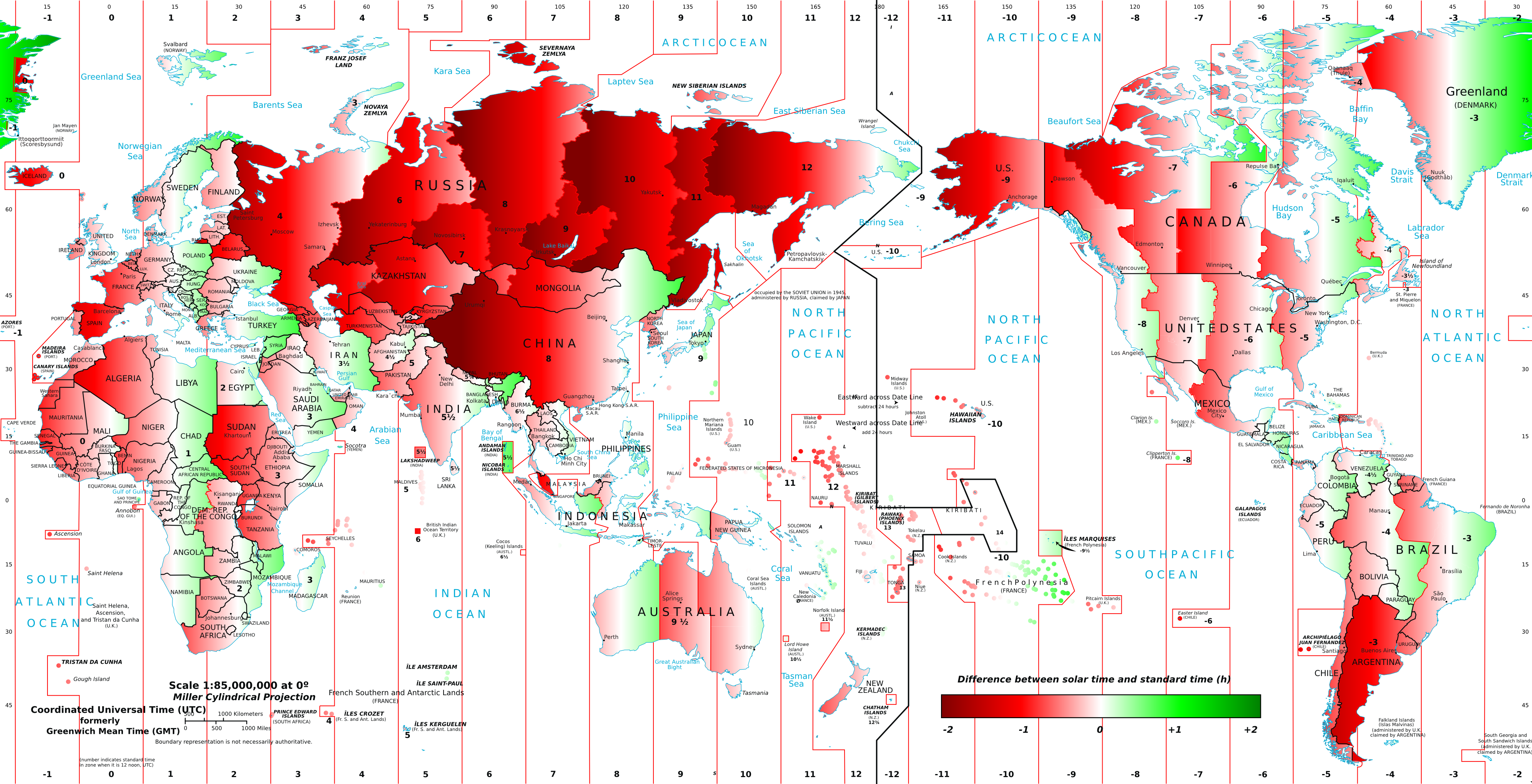
The clocks should show 4:45PM in Spain if the TZ was right (same as UK), and even so it would still be mostly red-white with barely any green. Poland appears white-green in the map, to have a bit of red it should be in a 1/2 TZ like India.
Minimum daylight (winter) in Warsaw is 7h 42m [0] and in Madrid 9h 17m [1]. Maximum (summer) is 16h 47m and 15h 4m. That is due to latitude and unavoidable. The exact numbers for sunset and sunrise are pushed around by the TZ choices.
Most of the world tends to prefer to not be too far from the center of the timezone (where solar noon matches solar time in standard time). Geographic and political boundaries make it so that often it's more red. The extremes of north and south tend not to care as much because it doesn't matter as much.
I don't think that explains it. The "red" offenders are basically Russia, China?, Sudan, Argentina and Alaska. The only "green" offender is Greenland, which is still large enough to enough red to justify it. I get China, it aligns with the population density. Sudan likely wants to have the same time as Somalia and Ethiopia. Why Argentina? Why Alaska? And why does Russia basically have zones that range from +2 to the +1 offset? They don't even have the excuse of avoiding 2 hour jumps like between Alaska and Canada, because they still have that.
Argentina is https://en.wikipedia.org/wiki/Time_in_Argentina - My speculation would be that Argentina (the east coast especially) wanted to be economically synchronized with the coastal cities of eastern Brazil. Buenos Aires and São Paulo being on the same timezone makes it easier for the two of them to do business.
Alaska used to have four timezones. In 1983, they were consolidated into two timezones - Aleutian and Alaska. Being in -9 rather than -10 brings Anchorage closer to the Pacific west coast in its business day with the note that it doesn't matter too much when solar noon is if sun is up for 22 hours or 5 hours.
Spaniards are a lazy bunch of party animals, waking up late and going to sleep late too...
Or the clocks are wrong. Once you realize noon is 13h in winter and 14h in summer, never 12h, things start to make sense. Late lunch? Not really, Sun at same height than Italy, but clocks off by 1.
For the "public image" part of the experiment, the conclusion is easy: bad. Time to change clocks so waking up happens at "3h" in the morning, and become a country of hard workers with no nightlife, because everyone retires "early". Even if discos are full as in the past.
>Kids walking, biking, and being driven to school in mornings in darkness ... that's also what permanent DST gives us.
I think this is the worst thing about it frankly, the kids. And you can't just push the school time back cause it interferes with the parents getting to work.



I respect there are economic arguments for permanent DST. But I question the road safety stat I hear with announcements like this. Kids walking, biking, and being driven to school in mornings in darkness ... that's also what permanent DST gives us.
Oh well, I am in the minority it seems. So R.I.P. "high noon" ... I'll never see you again here. And, yes, I understand that depending on where one is within a time zone, a true "high noon" is only in theory. But it's a nice ideal. :-)