OK...that's one side of the story. But is cost of living really being compared fairly? One $200 smart phone now does the job that in 1985 required a clock radio, a walkman, a CD player, a word processor, a printer, a fax machine, a telephone, a calculator, an address book and a voice recorder. How does this account for the multiplicative effect of technology on purchasing power?
And most people didn't have a word processor, a CD player, a printer, a fax machine, or a voice recorder. Which--and this might be shocking!--was by and large fine, as life had not been adapted to their presence.
"But society has stuck you with all this extra shit!" is not a good, moral, or acceptable response to "I am less able to pay my bills."
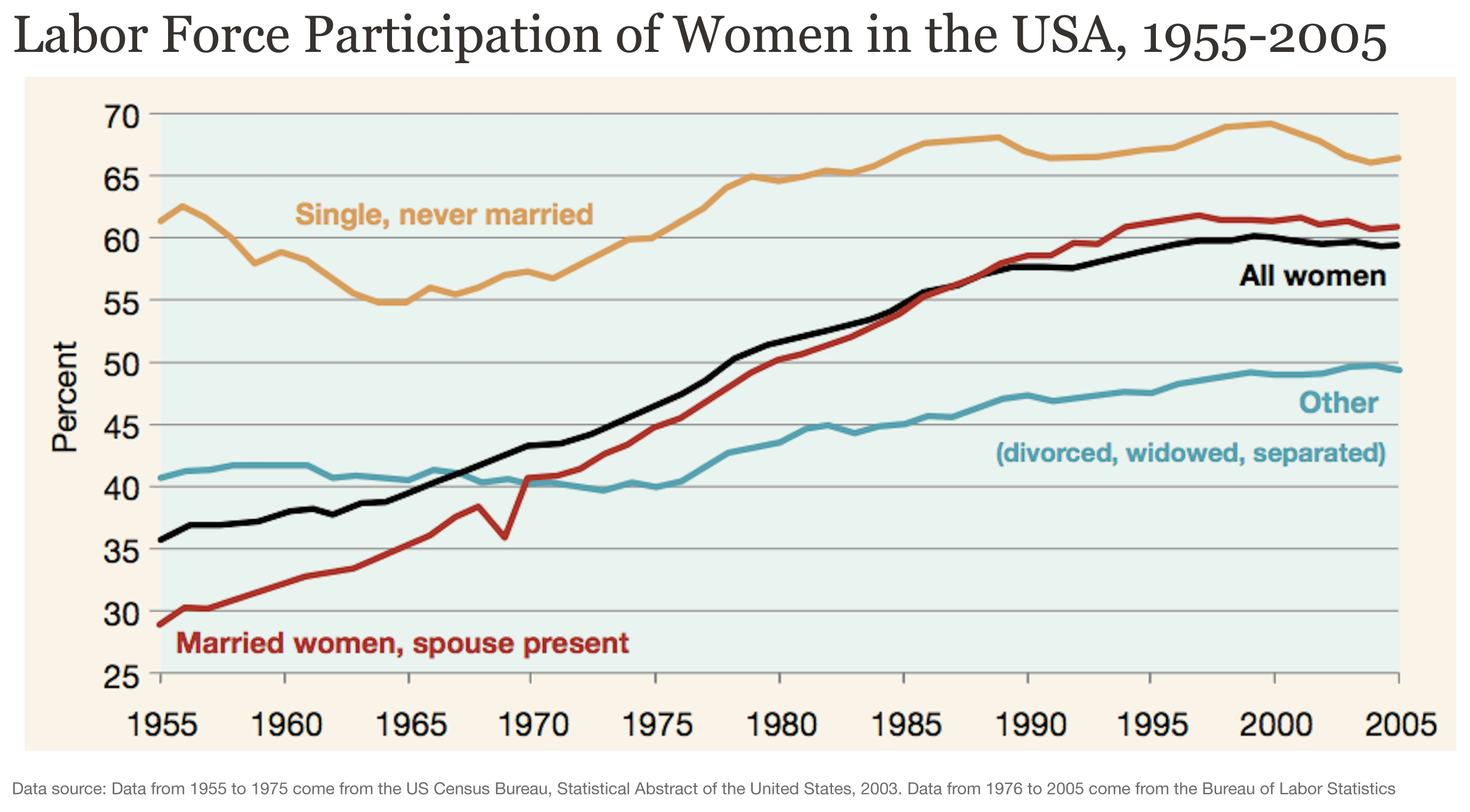
A large reason why wages have essentially "stagnated" is because the workforce has doubled with the advent of women entering the workforce. Laws of Supply and Demand say that wages should go down...it is to be expected. This is why for many a two income household is now necessary for a family these days.
While the employment rate for "Married women, spouse present" doubled from 1955 to 1990 (which may be what you're referring to), the rate for "All women" between 1985 and 2005 went from 55% to 60% (and falling).
Yes I was referring to that statistic; but I think it it more representative of the cause of wage stagnation. We had a flood of people come into the workforce in a few decades that were not there previously. Although the statistic that you provided is interesting...I think maybe we should not be looking at ALL women? I say this because many women may be in school still or retired and don't want/need to work.
> After being bombarded with questions about food inflation, [The Federal Reserve's] Dudley attempted to reassure his audience by putting rising commodity prices into a broader economic context — but that only made matters worse.
> “When was the last time, sir, that you went grocery shopping?” one audience member asked.
> “Today you can buy an iPad 2 that costs the same as an iPad 1 that is twice as powerful,” he said.”You have to look at the prices of all things.”
> This prompted guffaws and widespread murmuring from the audience, with one audience member calling the comment “tone deaf.”
It might be time deaf but it's also true. Inflation is measured by looking at what people actually buy - it will measure iPads to the extent people are spending money on iPads.
Now, if working class people spend less than average on iPads, then the inflation they experience will be different. But the government isn't going to produce dozens of different inflation metrics for different groups. Maybe they should - it's theoretically possible to calculate inflation based on consumption groups. Margins of error would be higher. But to suggest that they should just exclude quality improvements on technology completely is wrong.